
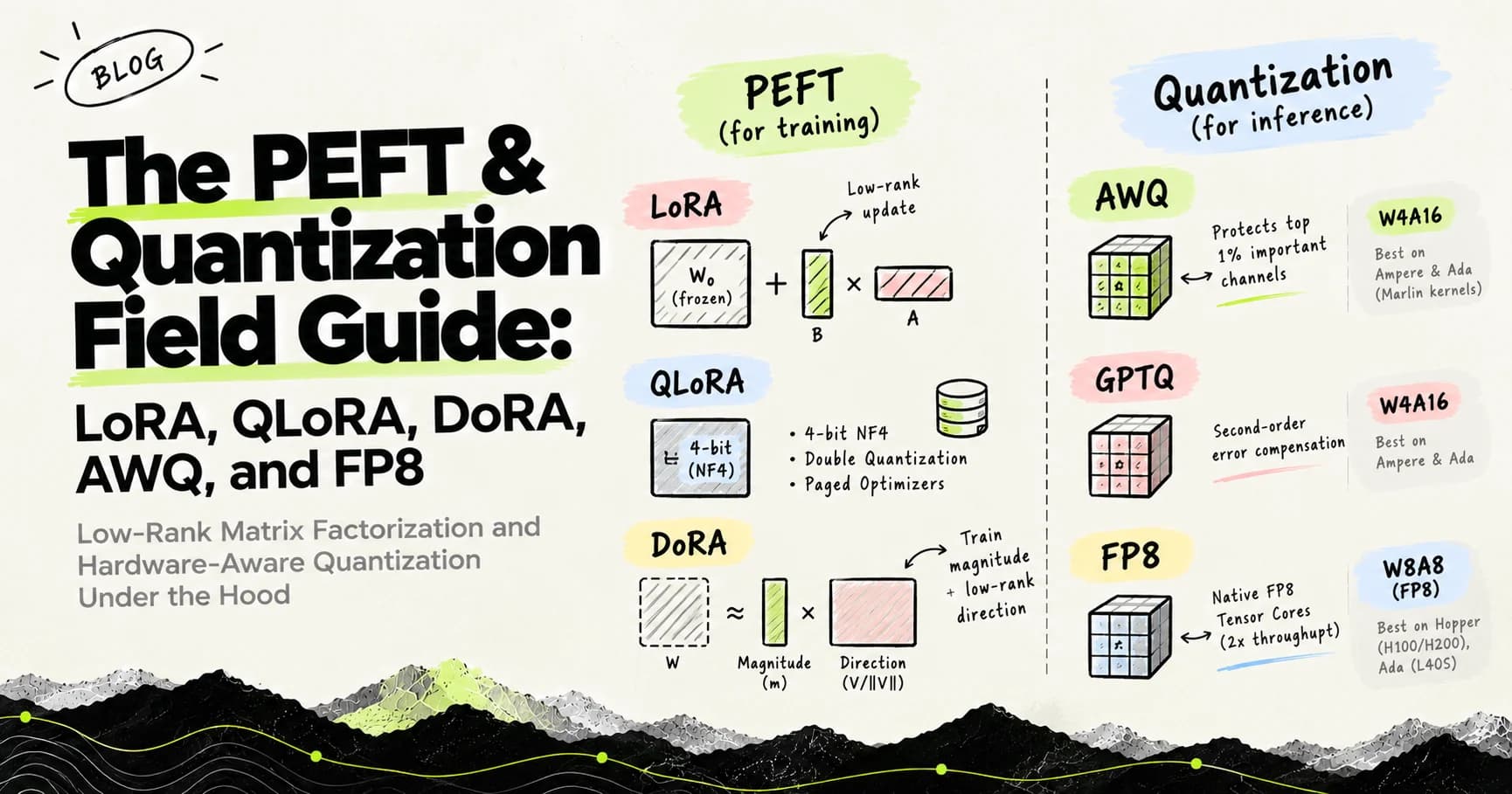
1. Executive Summary#
Fine-tuning and deploying large models within realistic GPU budgets requires mastering two orthogonal techniques: Parameter-Efficient Fine-Tuning (PEFT) for training, and Post-Training Quantization (PTQ) for inference. Treating these as black-box config flags leads to degraded accuracy and suboptimal throughput.
2. PEFT Internals: LoRA, QLoRA, and DoRA#
A. LoRA (Low-Rank Adaptation, Hu et al. 2021)#
Based on the hypothesis that weight updates during adaptation have a low "intrinsic rank," LoRA freezes the pre-trained weight matrix W_0 (dimension d x k) and injects two small trainable matrices A (r x k) and B (d x r), where rank r << min(d, k):
W = W_0 + (alpha / r) * (B * A)
- Zero Inference Overhead: Once trained,
B * Ais multiplied out and added directly intoW_0, adding zero latency at serving time. - Best Practice: Always apply LoRA to all linear layers (
q_proj, k_proj, v_proj, o_proj, gate_proj, up_proj, down_proj), not just attention Q and V. Rankr = 16to64withalpha = 2 * ris the empirical sweet spot.
B. QLoRA (Dettmers et al., 2023)#
Reduces fine-tuning memory by 4x via three innovations:
- NF4 (4-bit NormalFloat): Pre-trained neural network weights follow a zero-centered normal distribution. NF4 uses information-theoretically optimal quantiles spaced unevenly so each 4-bit bin holds an equal number of weights.
- Double Quantization: Quantizes the quantization scaling constants themselves from FP32 to FP8, saving ~0.37 bits per parameter.
- Paged Optimizers: Uses NVIDIA unified memory to automatically page AdamW optimizer states to CPU RAM during sequence-length memory spikes.
C. DoRA (Weight-Decomposed Low-Rank Adaptation, Liu et al. 2024)#
Decomposes pre-trained weights into magnitude (m, a 1 x k vector) and direction (V / ||V||_c), applying LoRA strictly to the directional component while training magnitude directly. DoRA closely mirrors full fine-tuning learning dynamics and consistently beats standard LoRA at lower ranks.
3. Inference Quantization: AWQ vs. GPTQ vs. FP8#
| Method | Precision | Core Mechanism | Best Hardware Target |
|---|---|---|---|
| GPTQ | W4A16 (4-bit weights, 16-bit activations) | Second-order Hessian (OBS) layer-by-layer error compensation | Ampere (A100, RTX 3090) & Ada |
| AWQ | W4A16 | Protects the 1% most salient weight channels identified by activation magnitude | Ampere & Ada (via Marlin kernels) |
| FP8 (E4M3) | W8A8 (8-bit weights & activations) | Native hardware FP8 Tensor Core execution without dequantization overhead | Hopper (H100/H200), Ada (L40S), Blackwell |
Senior Takeaway: On Hopper (H100) and Ada (L40S) GPUs, W8A8 FP8 is often faster under high batch concurrency than 4-bit W4A16 (AWQ/GPTQ). Why? Because W4A16 must dequantize 4-bit weights back to FP16 in registers before executing FP16 matrix math, making it compute-bound at large batch sizes, whereas W8A8 executes natively inside FP8 Tensor Cores at 2x the FLOP rate.